AI Solutions for Streamlined Logistics and Seamless Data Integration
In the rapidly changing landscape of logistics, companies are constantly looking for ways to streamline operations and boost efficiency. DigiTrans develops a Digital Entry Automation (DEA) solution, designed specifically for logistics companies, that transforms manual data entry with advanced AI-powered document recognition.
Introducing DigiTrans
DigiTrans is an artificial intelligence partner for logistics companies. They help their customers reduce manual work and boost productivity. The company specialises in AI solutions that drive innovation in the logistics sector. Our collaboration with DigiTrans showcases our expertise in AI model development and MLOps: we demonstrate how an AI solution can improve document and data management, a critical aspect of day-to-day logistics operations.
Navigating document complexity
The logistics industry is overwhelmed by document variety: generated PDFs, Excel files, scanned documents, orders arriving in emails. For DigiTrans' customers, handling this influx efficiently is a real challenge. Traditional document processing is labour-intensive, error-prone, and struggles to keep pace with growing data flows. The result: a need for a robust solution that can accurately extract data and feed it into logistics companies' systems.
Our team works closely with DigiTrans to build an AI solution tailored to the logistics industry. Using advanced machine learning (ML) models and semantic AI, we created a system capable of extracting, classifying, and analysing information from diverse document formats.
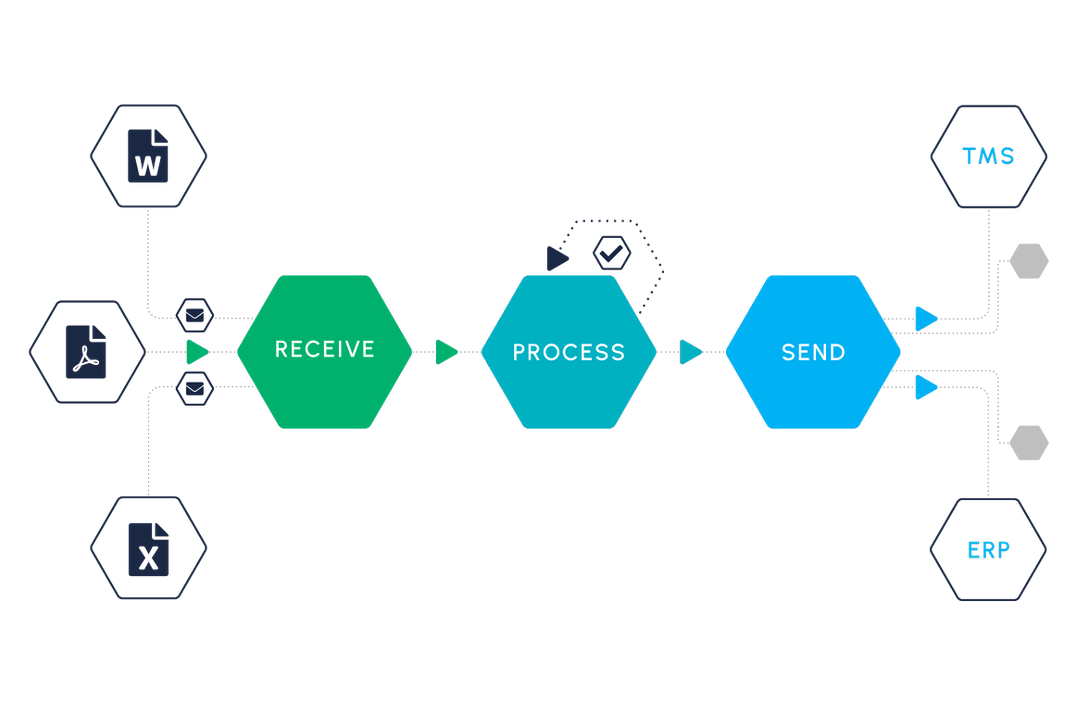
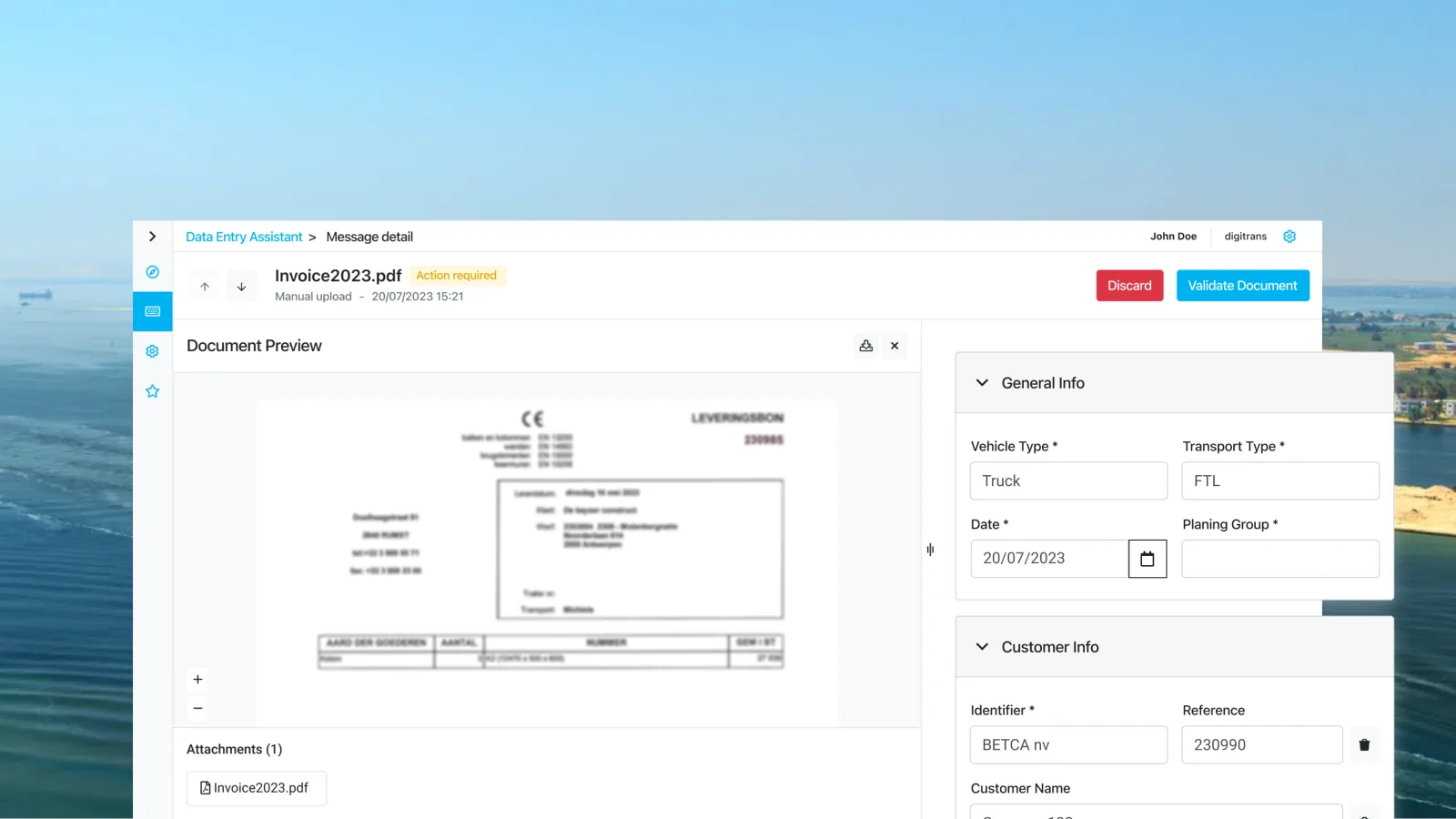
In practice, the end user forwards all documents to a data-entry assistant via email. Every message received at that address is automatically processed into a machine-readable file and sent to a preferred system, such as a transport management system or ERP.
Taking the necessary steps
- Understanding customer needs: our team of data scientists and developers ran an in-depth analysis of the challenges DigiTrans customers face, identifying the key pain points to address.
- Examining data sources: an experienced data scientist reviewed every data source and standardised the processing of PDFs, scanned documents, and emails for consistency and reliability.
- Unifying NLP model input: we built a tool to extract and standardise information from various document formats, enhancing data quality and converting PDFs into user-friendly formats.
- Organising document labelling: we rolled out a document-labelling tool that lets a dedicated team label documents efficiently. Clear guidelines and QA protocols keep accuracy high.
- Training the NLP model: our NLP model goes through a structured three-step training process to accurately extract the information DigiTrans needs.
Using open-source tools
To bring the solution to life, we use a range of open-source tools:
- PyTorch for analysing, interpreting, and classifying documents.
- Google Translate to deliver accurate translations, addressing the need to process multilingual documents.
- Tesseract OCR to convert document images into machine-readable text, improving text-recognition accuracy.
- Python as our development backbone, for building the applications and orchestrating the AI models.
- OpenCV for image pre-processing to improve document readability and precise text extraction.
- Nomad and Docker for deploying the applications and AI models.
Implementing AI into production
Developing the AI models was just the beginning. To genuinely improve logistics data management, we integrated MLOps practices into the solution. MLOps lets us automate workflows, ensure continuous integration, and streamline deployment and management of the models in production.
This approach improves how our AI models reach production. It keeps the solution flexible, with the ability to keep learning and improving continuously.

Transforming document management
The AI system delivers:
- Increased efficiency: automated document processing significantly reduces manual data entry and errors.
- Scalability: the microservices architecture, combined with MLOps, lets the solution scale with growing needs.
- Continuous improvement: MLOps practices keep deployment and monitoring continuous, so the system stays current with the latest advances.
- Better data accuracy: advanced NLP and ML techniques give precise text recognition and analysis, improving overall data quality and reliability.
Through this collaboration we showed how our expertise in AI model development and MLOps can optimise document and data management in logistics. If DigiTrans' transformation inspires you and you're ready to lift your business or project with similar outcomes, get in touch to explore what's possible.
Interested in similar results?
Let's discuss how our engineering teams can help your business scale.