What is IT staff augmentation? A 2026 buyer's guide

TL;DR
IT staff augmentation means renting individual senior engineers who join your existing team and report to your tech lead. You keep ownership of the product, the architecture, and the standups. The vendor handles employment, payroll, and replacement risk. It works well when you have a team that knows what to build but lacks the hands to ship it. It's the wrong tool when you need someone to own a problem from first principles, when the engagement is shorter than a sprint, or when regulated work blocks foreign contractors. European day rates for senior engineers in 2026 typically run 30–40% below Western European and US equivalents when sourced from Poland, without sacrificing seniority. We run IT staff augmentation services as one of four ways our clients work with us.
The plain-English definition
Staff augmentation is a contractual arrangement where a vendor places one or more engineers into your team, on your timezone, on your tools, reporting to your tech lead. Your developers, just not on your payroll.
That's it. There's no shared service desk in the middle. No project manager passing tickets between camps. No statement-of-work that splits the codebase into "ours" and "theirs." The augmented engineer joins your standup, opens pull requests against your repo, goes through your code review. The vendor's job is upstream of all that: find them, vet them, employ them, replace them if it doesn't work, and stay out of the way.
A working definition I keep coming back to on first calls: staff augmentation is renting an engineer. Outsourcing is renting an outcome. That distinction is the whole game.
Staff augmentation vs the alternatives
If you're shopping for engineering help in 2026, four shapes show up. They're easy to confuse because vendors often sell two or three of them under the same brand.
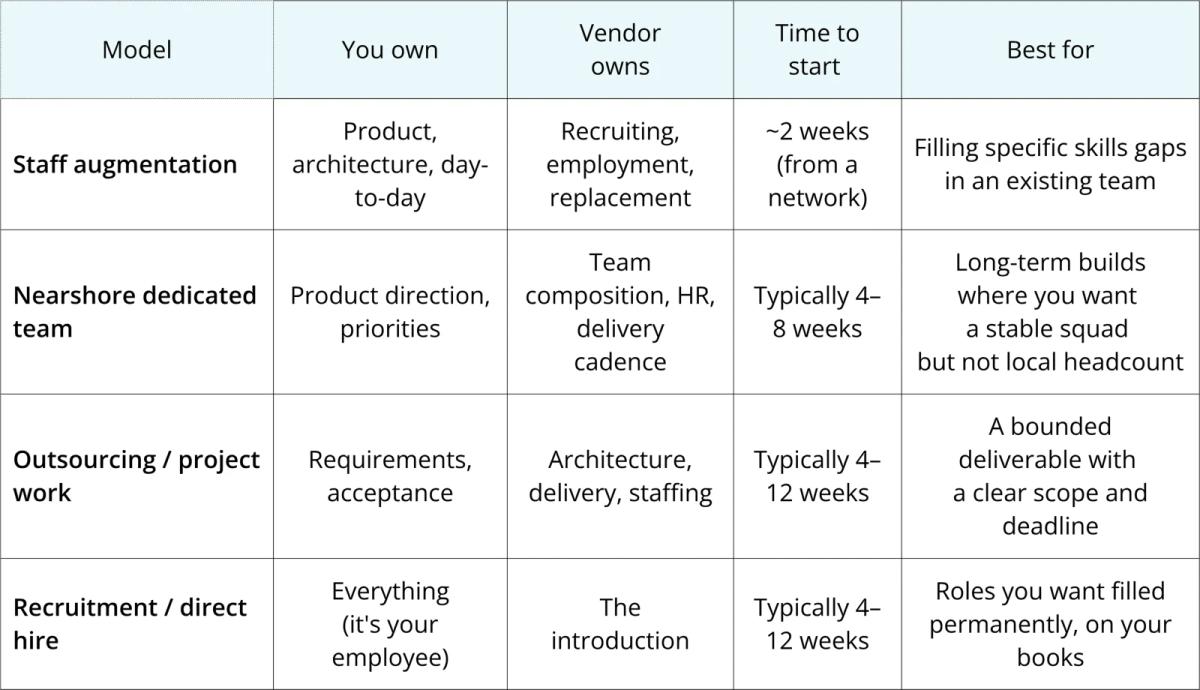
The single column that matters most is "you own architecture." If the answer is yes, you're in the staff aug column. If you want someone else to own architecture and bring a team, you're in nearshoring or outsourcing. Mixing those models inside one engagement is where projects go sideways. Two parties both think they own the same decisions, and nobody does.
When IT staff augmentation is the right model
Three patterns show up over and over:
- You have a roadmap and not enough hands. Your team knows what to build. You've shipped before. Hiring full-time would solve it but local recruiting often takes several months in competitive markets and you need someone next sprint. Augmentation closes the gap without committing you to permanent headcount.
- You need a skill your team doesn't have yet. A six-month migration to a new database, a Kubernetes consolidation, a one-off iOS rewrite. You don't want a full-time hire for a six-month problem. An augmented senior fills the skill, transfers context, and leaves clean.
- You're scaling a working team and don't want HR overhead in a foreign market. Polish employment law, payroll, work permits, sick leave handling. None of that is your business. The vendor takes the operational layer; you get a working engineer in CET or close to it.
If you recognise your situation in two of those, staff aug is probably the right model. We see this most often with US and Western European product companies between 50 and 250 people. Past the founding squad, before they have an in-house global mobility team. That's the band where Inuits does most of its work.
When it isn't the right model
Staff augmentation gets sold into situations where it's the wrong fit, and the project pays the price six months later. Three honest counter-cases:
- You don't have a tech lead. Augmented engineers report to your tech lead. If there isn't one, the engagement turns into freelance work without supervision, and freelance work without supervision drifts. Hire the lead first.
- The work is shorter than 4–6 weeks. Onboarding to your codebase, conventions, and team takes time. For anything under a month, a fractional or gig engagement (a focused sprint, a security audit, an architecture review) is cheaper and faster.
- Greenfield product where you need product ownership, not capacity. When the question is "what should we build?", not "how do we ship faster?", you don't need an extra pair of hands. You need a partner. Look at outsourcing or a senior contract hire.
We've turned engagements down on all three. The rule is simple: if we can't see how the augmented engineer succeeds in your team within 30 days of starting, we say so on the first call.
What good staff aug looks like in 2026
The bar moved over the last three years. Buyers are more sophisticated. Here's what serious operators expect now:
- Vetting that actually means something. A staffing partner should be able to tell you, in a sentence, why a candidate is in their network. Not "they passed our screening." Specifics: which production systems they've shipped, which interview signal they nailed, who in the network referred them. Curated networks beat scraped CVs every time. We'd rather send three candidates we believe in than 30 we don't.
- Time-to-first-developer measured in weeks, not months. For most senior roles in our network we hit ~2 weeks from first call to first standup. Anything north of 6 weeks usually means the vendor is recruiting from scratch instead of placing from a network. Fine if you've planned for it. Dangerous if you haven't.
- Replacement risk handled at the contract layer. What happens if the engineer leaves three months in? A mature contract names the SLA: a replacement candidate within 2 weeks, knowledge transfer billed or unbilled depending on cause. Read this clause before you sign.
- IP and confidentiality that survives the engagement. All work product assigns to you. The vendor signs the same NDAs your full-time staff sign. The augmented engineer signs them too. If a vendor treats this as a back-office detail, walk away.
- Direct access to the engineer. No proxy. If the vendor's first instinct is to interpose an account manager, you're paying for a layer that wasn't there at the start.
What it costs
Specific 2026 rate bands depend on technology, seniority, and engagement length, and we publish them under NDA rather than in a blog post. The shape of the cost is more useful publicly:
A senior engineer in Poland is typically priced 30–40% below the Western European or US equivalent for comparable seniority, and the gap can run wider against the more expensive Western European markets specifically. That's not because the talent is cheaper. Polish developers have historically ranked near the top of HackerRank's country rankings and many have shipped at international product companies, including the Google, IBM, and Cisco offices that operate in Krakow and Warsaw. It's because Poland's cost of living is different, and the rate reflects that.
Inside that headline number, the price covers four things: the engineer's compensation, employer-side social contributions (Poland's employer rate runs roughly 20–22% of gross salary, depending on accident insurance and PPK participation), recruiting and retention cost, and a vendor margin that pays for the network, vetting, and replacement guarantee. Vendors that quote rates noticeably below the market band are usually compressing one of those four. The first to give is retention. Which is why the cheapest agency you can find tends to ship the highest churn.
If you want a current band for a specific role and seniority, send the brief and we'll come back with a number you can plan against.
How to evaluate a staff aug partner: 7 questions to ask
Use these on the first call. Vague answers are the signal.
1. How do you source candidates?
You're listening for "curated network" with specifics, not "we post on job boards." Ask how many engineers are in their active network and how many are placed at any given time.
2. How long from first call to first developer in our standup?
Two to four weeks is the answer for senior roles when the partner places from a network. Six to twelve weeks means they're recruiting from scratch.
3. What happens if the engineer leaves?
Listen for a named SLA: replacement candidate timeline, knowledge transfer terms, what triggers it. "We'll work something out" is a red flag.
4. Who do my developers report to?
The right answer is "your tech lead." Anything else means there's a layer between you and the work.
5. How do you handle Polish (or local) employment, taxes, and compliance?
You should hear the answer in 30 seconds. If they need to come back to you on this, they're new at it.
6. Can I talk to the engineer directly during the interview?
Yes is the only acceptable answer. If the vendor wants to gatekeep, they're protecting margin, not quality.
7. What's a recent engagement that didn't work, and why?
The honest answer to this question separates serious partners from sales pitches. Anyone who's placed engineers for three years has stories. The willingness to tell one, with specifics, is the trust signal.
FAQ
Where to go from here
If you want to test the model with one role, that's the cleanest place to start. Send us the brief (the role, the team, the timeline) and we'll come back with three candidates and a rate band within a week. If we can't help, we'll say so on the first call. You can also read about how we run nearshore dedicated teams when the work needs a full squad, or how we handle direct recruitment when you want the engineer on your payroll instead of ours. One partnership, four ways to staff your roadmap.
Interested in working with us?
Let's discuss how we can help your team ship faster.
Comments
Share your thoughts.